Financial planner (FPE) (Burgdorf):
1 Provider - 1 Training locations



Immediately to the right training
Baarerstrasse 137
6302 Zug


Schools with certified educational counseling

Sites in the region Berne and Burgdorf:
Education location / Burgdorf schools
Questions and answers
What continuing education, further training options are available after earning the Financial Planner certification?
The Swiss Federal Certificate in Financial Planning can serve as a foundation for further specializations and advanced degrees in the field of finance. Depending on one’s educational background, professional experience, and the respective admission requirements, continuing education, further training programs in the following areas, for example, may be an option:
- Financial and Investment Counseling: Deepening expertise in comprehensive financial counseling and asset allocation.
- Asset Management: Specializing in the management and administration of investment assets.
- SME Financing: An in-depth look at financing issues and financial management for small and medium-sized enterprises.
- Advanced vocational and university-level continuing education: Depending on prior education and admission requirements, this may include, for example, courses at the CHE level as well as CAS or MAS programs.
The best continuing education, further training program for your next step depends on your current field of work and your career goals. Therefore, be sure to review the current admission requirements for the program in question before applying. This will help you decide whether you want to specialize in a particular field or pursue an advanced degree.
Be sure to check out ourGuide to banking, financial planning and insurance.
What is the structure of the Federal Professional Examination for financial planners?
The federal final exam currently consists of two parts. In the first section, “Topics in Financial Planning,” candidates are tested on retirement planning and investment strategies in a 90-minute written exam. The second section, “Financial Planning for Private Households,” consists of a 240-minute written exam and a 30-minute oral exam.
For the final grade, the “Topics in Financial Planning” section of the exam accounts for 30 percent, and “Financial Planning for Private Households” accounts for 70 percent. Both sections of the exam must be taken at the same time; it is not possible to take them separately.
In short:You should not only prepare for individual areas of expertise, but also learn how to integrate various financial topics into a comprehensive financial plan for households.
Read more about thecosts incurred.
What are the admission requirements for the financial planning continuing education program that includes the Federal Professional Examination?
To be eligible to take the Federal Professional Examination to become a financial planner with a federal certificate, you must meet one of the following requirements regarding basic education and professional experience:
- With at least three years of basic education: You hold a Federal Diploma of Vocational Education and Training (EFZ) or an equivalent qualification and have at least two years of professional experience in the financial services sector.
- With a two-year basic education: You have successfully completed a two-year basic education program and have a total of five years of professional experience. At least two of those years must have been spent in the financial services sector.
- With Professional Experience but Without the Required Basic Educational Qualification: You may be admitted even without one of the listed educational qualifications if you can demonstrate at least five years of professional experience in the financial services sector.
You'll also need the following fourModule completionsthe IAF Certified Financial Advisor professional examination or equivalent certifications:
- Assets (including FIDLEG)
- Pension provision (personal and social insurance)
- Insurance (property and asset insurance)
- Real estate
Meeting these requirements will allow you to be admitted to the Federal Professional Examination. SERI determines the equivalence of foreign certificates and diplomas.
As a financial planner, can I use the title “Professional Bachelor”?
Yes. Starting October 1, 2026, holders of a federal vocational certificate may use the corresponding title designation “Professional Bachelor” alongside the protected federal title. The title suffix is not a standalone bachelor’s degree and does not replace the federal vocational certificate.
For financial planners, this means that the protected title “Financial Planner with a Federal Certificate” will remain in effect; starting October 1, 2026, the corresponding title suffix may also be used. The new regulation also applies to individuals who obtained their professional certificate earlier.
Read more aboutAwareness and imageof the degree.
Financial Planner Exam: How Can I Prepare Effectively?
Targeted preparation for the financial planner exam will help you solidify the necessary expertise and apply it to complex client situations. It’s not just about memorizing the material—it’s also crucial to understand financial concepts, evaluate different solutions, and provide clear, well-reasoned justifications for your recommendations.
The following study strategies have proven effective for exam preparation:
- Create a study plan: First, get an overview of the exam content and break the material down into manageable topics. Schedule regular study sessions and set aside enough time for review and practice exams.
- Systematically review your subject matter knowledge: Delve deeper into the key topics of financial planning, particularly assets, retirement planning, insurance, real estate, financing, and tax and legal considerations. Use summaries, flashcards, and your own overviews to reinforce important terms and concepts.
- Practice with case studies: Train using real-life customer scenarios. For example, analyze the financial situation of an individual or family, taking into account income, assets, retirement planning, and financial obligations, and develop appropriate solutions based on that analysis.
- Practice Exam Questions: Work through past exam questions and similar practice problems under realistic conditions. This will help you identify which topics you already have a good grasp of and where you still have gaps in your knowledge.
- Take practice exams: Practice the written portions of the exam within the allotted time. Also prepare for the oral exam by clearly presenting financial planning solutions and providing professional justifications for your recommendations.
- Connecting Concepts: Holistic financial planning requires you to link different topics together. Therefore, practice understanding how, for example, real estate financing affects retirement planning, your tax burden, or long-term wealth planning.
In addition to self-study, a targeted prep course can be helpful. There, you can clarify any questions you have, work through complex problems together, and familiarize yourself with the requirements of the financial planner exam.
It's important that you don't wait until right before the exam to start working on case studies and practice exams. The sooner you put what you've learned into practice, the better you'll be able to reinforce your knowledge and build your confidence for the exam.
Read more about theStructure of the Federal Professional ExaminationFinancial Planner.
For whom is the Federal Diploma of Higher Education in Financial Planning suitable?
The Federal Diploma of Higher Education in Financial Planning is suitable for people who already work in the financial or insurance sector and would like to develop their skills in the direction of holistic financial advice. A Financial Planner continuing education, Higher Education or Federal Diploma of Higher Education in Financial Planning builds on your professional experience and significantly deepens your specialist knowledge.
Typical target groups are:
- Employees in banks, insurance companies or trust companies
- Persons from the financial advisory or investment advisory sector
- Specialists in the field of pension, tax or investment advice
- Individuals with relevant educational background and several years of professional experience in the financial services sector
The Federal Diploma of Higher Education in Financial Planning is particularly suitable for anyone who wants to advise clients holistically on topics such as budgeting, pensions, taxes, real estate and asset accumulation. It not only teaches product knowledge, but also builds up comprehensive financial planning skills.
Conclusion: The Federal Professional Examination is ideal for financial professionals who want to expand their advisory skills and develop their career to a higher level in finance. Find out about suitable courses or request non-binding documents to plan your next career move.
Read more aboutEvaluation and Assessment of Former Graduates.
What activities do financial planners with a federal certificate carry out?
Financial planners with a federal certificate provide comprehensive advice to individuals—and, in some cases, businesses—on all financial matters throughout their lives. A financial planning continuing education program or the Federal Professional Examination for financial planning leading to a Federal Diploma of Higher Education qualifies you to provide private financial planning services throughout a client’s entire life cycle.
The most important activities include:
- Holistic financial planning, including income, budget and asset structure
- Pension advice, e.g. AHV, pension fund and private pension provision
- Tax planning and tax optimization within the scope of legal possibilities
- Investment and wealth management advice tailored to your goals and risk profile
- Real estate and mortgage advice, e.g. financing of residential property
- Analysis of the overall financial situation and development of individual solutions
A Financial Planner continuing education, Higher Education or Federal Diploma of Higher Education in Financial Planning provides both specialist knowledge and advisory skills so that clients can be financially secure in the long term.
Conclusion: Financial planners play a central role in holistic financial advice and support clients in making important financial decisions. Find out about suitable continuing education, further training or request non-binding documents to enter this demanding professional field.
Create a financial plan: What can you do as a financial planner IAF and with a Federal Diploma of Higher Education?
As a financial planner, you can guide individuals and families through important financial decisions and create a financial plan tailored to their life circumstances. This involves considering not only individual products or investments, but also their overall financial situation and how it evolves across different stages of life. The specific advisory services you can offer depend on your qualifications, professional experience, and the nature of your work.
A financial plan may include the following areas in particular:
- Income and Expenses: Analysis of the Budget and Financial Resources.
- Assets and Liabilities: An overview of savings, investments, mortgages, and other obligations.
- Retirement Planning and Retirement: Assessing your retirement situation, identifying potential gaps in your retirement coverage, and planning for your financial situation after retirement.
- Insurance and Risks: Analysis of financial protection in the event of illness, accident, disability, or death.
- Taxes: Taking Tax Implications into Account When Making Financial Decisions.
- Real Estate and Financing: Planning the financing of home ownership and assessing long-term affordability.
- Investments and Wealth Building: Developing an investment strategy tailored to your personal goals and risk tolerance.
- Estate Planning: Addressing Inheritance Issues and Ensuring Financial Security for Family Members.
A financial plan is especially helpful during major life events. These include, for example:
- Starting a Family or a Change in Family Circumstances
- Buying or Financing a Property
- Inheritance or Significant Changes in Assets
- Divorce or Separation
- Starting a Self-Employed Business
- Planning for Early Retirement or Regular Retirement
Creating a financial plan therefore involves linking various financial topics and taking potential developments into account early on. To do this, financial planners analyze the initial situation, identify possible courses of action, and develop appropriate solutions. If you’re interested in this career, you’ll find more information about the courses and educational providers on our page for continuing education, further training to become a financial planner with a federal certificate.
What do you learn about due diligence in a financial planner continuing education, further training program?
In a continuing education, further training program to become a financial planner, you’ll learn to carefully analyze financial situations, identify client needs, and provide clear, well-reasoned explanations for your recommendations. This also includes handling confidential client data and potential conflicts of interest responsibly. The specific legal obligations that apply in your day-to-day work depend on the financial or insurance services you offer and the role you hold.
Key aspects of professional due diligence include:
- Thorough Needs Assessment: You assess your clients’ personal and financial situations, as well as their goals and needs, before developing recommendations.
- Data Protection and Confidentiality: You handle personal information, financial details, and client files responsibly and comply with applicable data protection regulations.
- Transparent Documentation: You record important information, consultation steps, and recommendations in a way that ensures the basis for decision-making remains transparent.
- Transparency and Conflicts of Interest: You identify potential conflicts of interest and handle them openly. Depending on your role, there may be specific legal requirements regarding disclosure or avoidance.
- Information and Education: You explain financial solutions, products, costs, and risks in a way that is easy to understand, and you comply with the disclosure requirements applicable to your work.
- Staying Up to Date on Industry Developments: You keep your knowledge of legal requirements, retirement planning, taxes, and financial products up to date.
Depending on the nature of the business, the Financial Services Act (FIDLEG) and the Insurance Supervision Act (VAG) may also apply. Among other things, the FIDLEG contains requirements for the faithful, diligent, and transparent provision of certain financial services. The VAG regulates, among other things, disclosure requirements and the handling of conflicts of interest in insurance brokerage. These regulations do not automatically apply equally to every activity in financial planning.
The duty of care is therefore an essential component of professional financial advising. It helps you responsibly consider your clients’ interests, provide clear and transparent justifications for your recommendations, and comply with applicable legal requirements. You can find out exactly which topics are covered in depth in each continuing education program by contacting the respective educational providers directly.
What is the difference between an IAF financial advisor and a financial planner with a Federal Diploma of Higher Education?
The IAF-certified financial advisor and the financial planner with a federal certificate are two different qualifications in the financial sector. They build on each other in terms of expertise, but they are not equivalent.
TheCertified Financial Advisor (IAF)is a certification offered by a professional association. It provides expertise in advising on various financial topics and can serve as a foundation for the advanced Federal Professional Examination to become a financial planner with a federal certificate.
TheFinancial Planner with a Federal Diploma of Higher Educationholds a federally recognized certification at the Federal Professional Examination level. This qualification provides in-depth knowledge of comprehensive financial planning for private clients. This includes, among other things, wealth accumulation, retirement planning, insurance, real estate, and financing, as well as tax and legal considerations.
If you wish to earn the Federal Certificate of Competence, you must meet the relevant admission requirements. These include the required professional experience as well as the necessary module certificates or certificates of equivalence. The IAF Certified Financial Advisor diploma may be recognized as an alternative to the individual module certificates.
Read more about the5 Facts About Financial Planner Training.
IAF Financial Planner: Which modules are required for the Federal Certificate in Financial Planning?
To be admitted to the federal final examination to become a certified financial planner with a professional certificate, candidates must have completed four modules of the IAF Certified Financial Advisor professional examination or provide equivalent certification. These include:
- Assets (including FIDLEG): Wealth accumulation, investments, and the relevant provisions of the Financial Services Act.
- Pension Planning: Personal and Social Insurance.
- Insurance: Property and Financial Insurance.
- Real Estate: specifically, the fundamentals of real estate financing.
Module completions must meet specific grade and validity requirements. Alternatively, the IAF Certified Financial Advisor diploma may serve as proof of eligibility.
The actual federal final examination consists of two parts: “Topics in Financial Planning,” which includes a 90-minute written exam, and “Financial Planning for Private Households,” which includes a 240-minute written exam and a 30-minute oral exam. In addition, certain requirements regarding prior education and professional experience apply for admission.
Anyone seeking to earn the IAF Financial Planner certification should therefore check not only the module requirements but also the personal admission requirements.
What is the significance of FINMA's recognition of the Financial Planner certification?
The Swiss Federal Certificate in Financial Planningis recognized by FINMA as a professional qualification for insurance brokerage in accordance with the Insurance Supervision Act (VAG).In addition, this certification is recognized by the regservices.ch advisor registry as proof of professional expertise and knowledge of the ethical obligations under the Financial Services Act (FIDLEG).
However, this recognition does not mean that the professional certificate constitutes a general “FINMA license” for all activities in the financial sector. The specific authorizations, registrations, or other requirements needed for a particular activity depend on the respective field of activity.
Read more about theDisadvantages of Financial Planner Training.
What skills does a financial planner training program teach?
Graduates of the Financial Planner training program, which leads to a federal certificate, acquire comprehensive professional skills to provide holistic financial advice to individuals. They learn to analyze different life situations, assess financial options, and develop personalized solutions. Key competencies include:
- Comprehensive Financial Planning: Thoroughly assessing financial situations, taking personal goals and needs into account, and developing long-term financial plans.
- Wealth Creation and Investment: Evaluate options for systematically building wealth, develop investment strategies, and assess risks and potential returns.
- Retirement Planning: Analyze your financial situation with regard to retirement and evaluate solutions within the 1st, 2nd, and 3rd pillars.
- Insurance: Identify insurance needs, review existing coverage, and recommend appropriate solutions for various life risks.
- Real Estate and Financing: Evaluate real estate financing options, analyze affordability and financing options, and assess mortgage solutions.
- Taxes and Law: Incorporate tax and legal frameworks into financial planning and take their implications into account when making financial decisions.
- Analysis of client situations: Assess income, assets, liabilities, retirement benefits, and personal goals, and use this information to determine the specific actions needed.
- Consulting and Implementation: Explaining financial concepts in an understandable way, recommending appropriate measures, and supporting clients as they implement their financial plans.
This enables financial planners with a federal professional certification to integrate various areas of finance and develop solutions tailored to their clients’ personal life and financial situations.
Read more about theBenefits of Financial Planner Training.
Tips, tests and information on "Financial planner with Federal Diploma of Higher Education"



 Error found? -

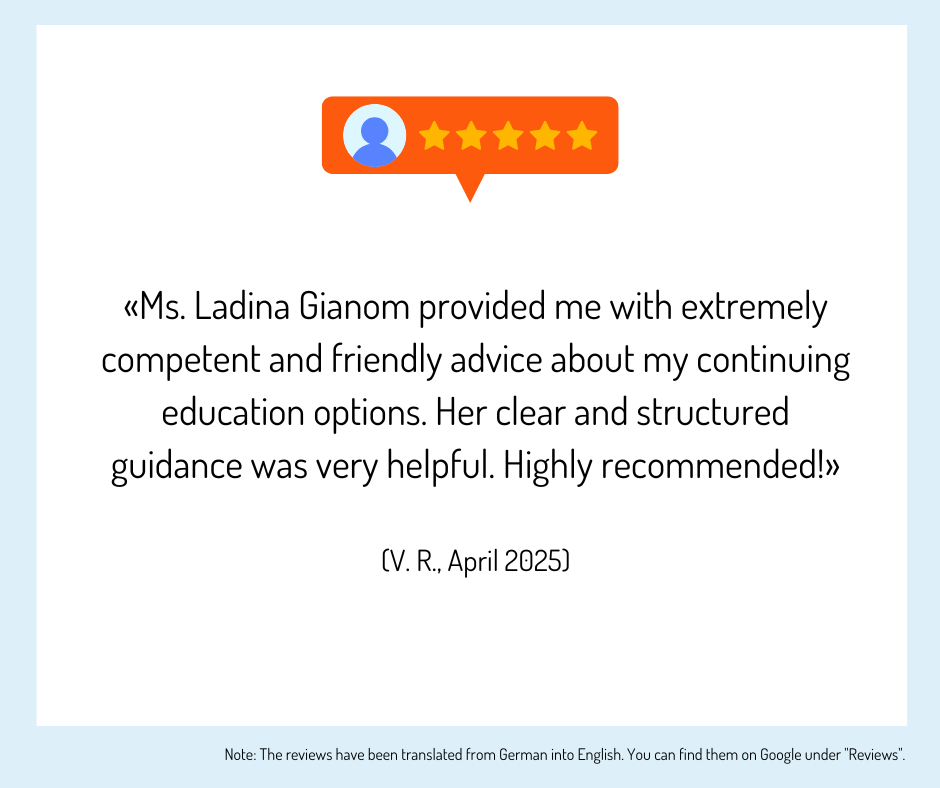
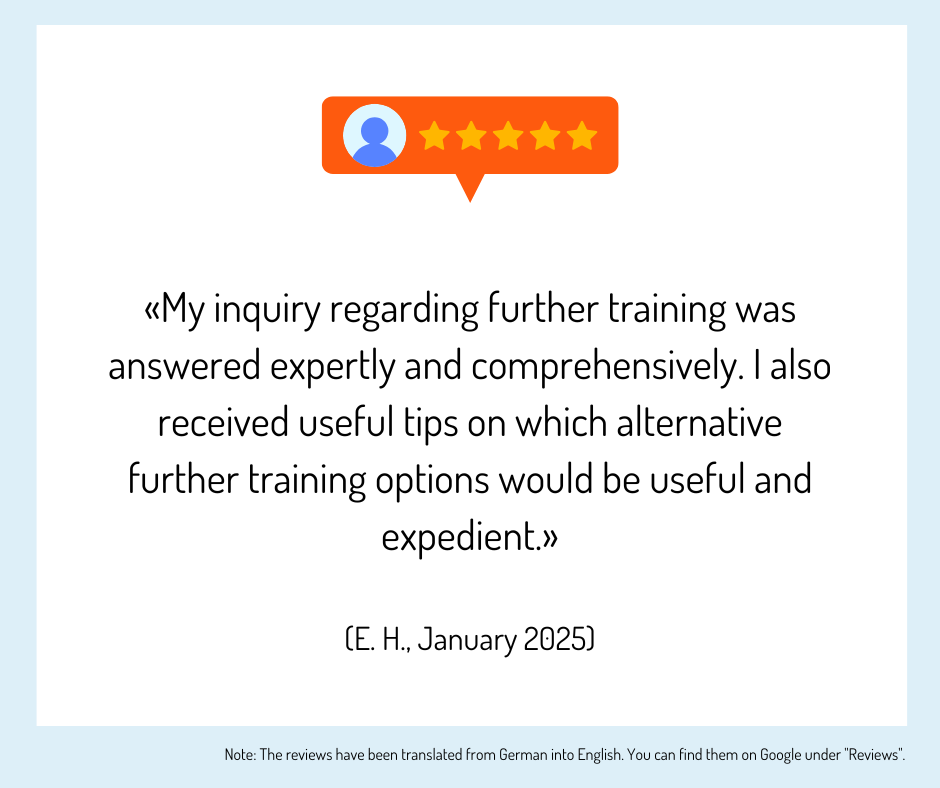
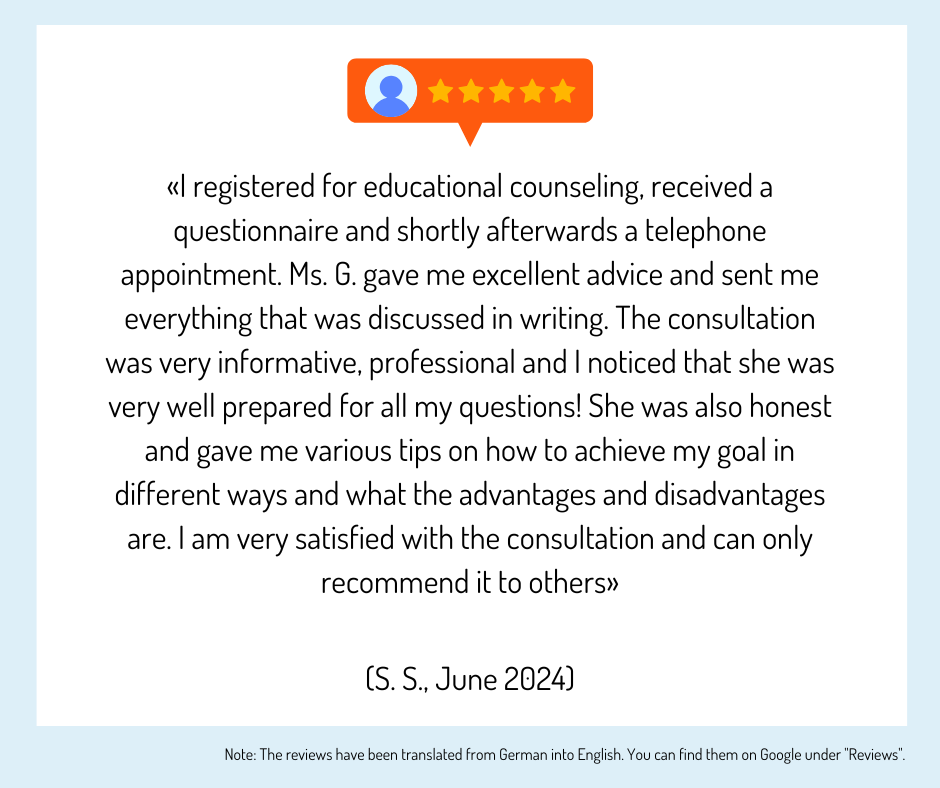
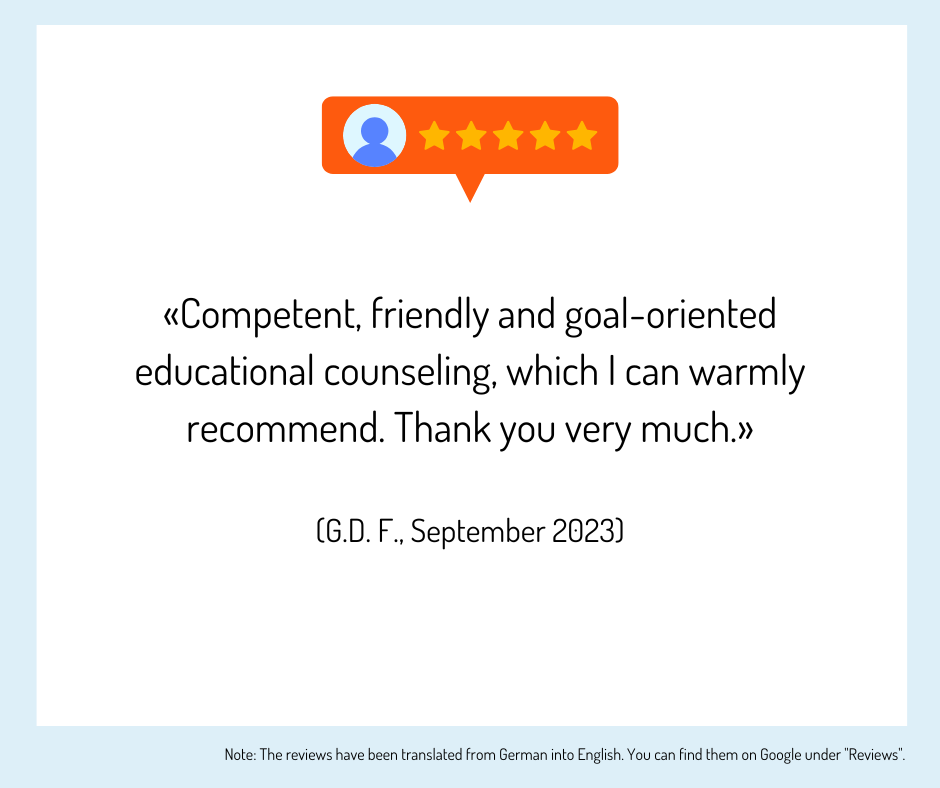
Experiences, evaluations and opinions on training / further education
Haven't found the right training or further education yet? Benefit from educational advice now!
Further training is not only important in order to maintain or increase professional attractiveness, investing in training or further training is still the most efficient way to increase the chances of a pay rise.
The Swiss education system offers a wide range of individual training and further education opportunities - depending on your personal level of education, professional experience and educational goals.
Choosing the right educational offer is not easy for many prospective students.
Which training and further education is the right one for my path?
Our education advisory team will guide you through the "education jungle", providing specific input and relevant background information to help you choose the right offer.
Your advantages:
You will receive
- Suggestions for suitable courses, seminars or training programs based on the information you provide in the questionnaire
- An overview of the different levels and types of education
- Information about the Swiss education system
We offer our educational counseling in the following languages on request: French, Italian, English
Register now and concretize your training plans.





Attraktive Services für SKO Mitglieder
Kostenlose Services
» Bildungsberatung (Wert: CHF 150.–)
Bildungs- und Businessratgeber (Wert: CHF 175.–)
» Rabatte
Attraktive Rabattierungen seitens der Bildungsanbieter.
Massgeschneiderte Bildungsangebote
Ohne grossen Zeitaufwand den besten Trainer, Coach oder Schulungsanbieter finden
Bildungsangebot Schweiz
Aus über 700 Bildungsanbietern das richtige Bildungsangebot finden

